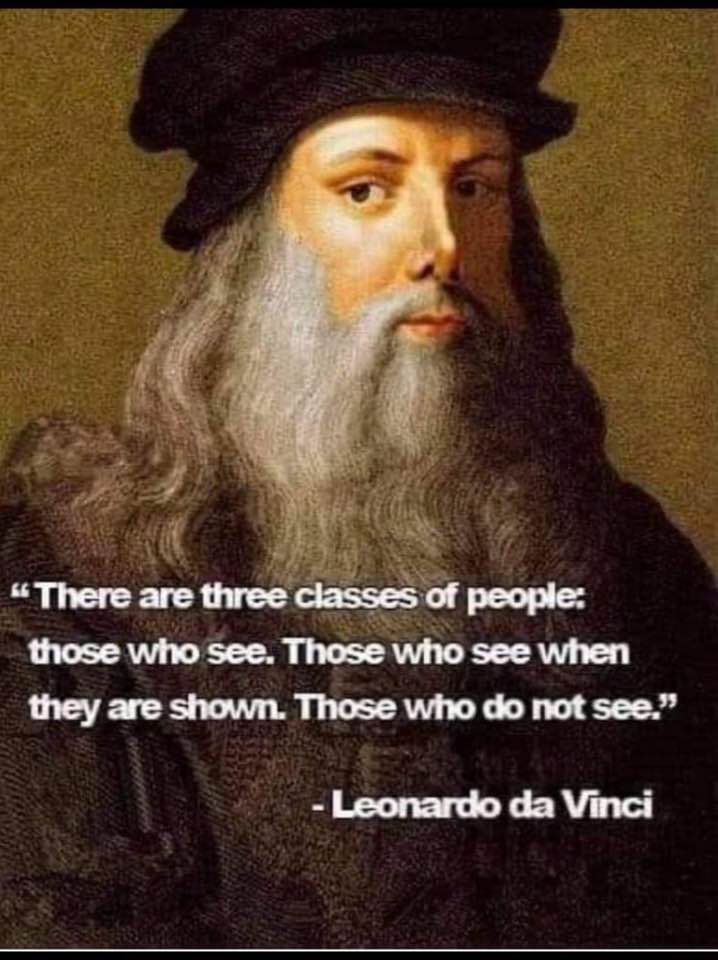
Leonardo di ser Piero da Vinci; Italian: more commonly Leonardo da Vinci or simply Leonardo (15 April 1452 – 2 May 1519), was an Italian polymath whose areas of interest included invention, painting, sculpting, architecture, science, music, mathematics, engineering, literature, anatomy, geology, astronomy, botany, writing, history, and cartography. He has been variously called the father of palaeontology, ichnology, and architecture, and is widely considered one of the greatest painters of all time. Sometimes credited with the inventions of the parachute, helicopter and tank, he epitomised the Renaissance humanist ideal.
Many historians and scholars regard Leonardo as the prime exemplar of the "Universal Genius" or "Renaissance Man", an individual of "unquenchable curiosity" and "feverishly inventive imagination". According to art historian Helen Gardner, the scope and depth of his interests were without precedent in recorded history, and "his mind and personality seem to us superhuman, while the man himself mysterious and remote". Marco Rosci notes that while there is much speculation regarding his life and personality, his view of the world was logical rather than mysterious, and that the empirical methods he employed were unorthodox for his time. Wikipedia, Leonardo da Vinci
Schauberger
The decisive factor here is il primo movere. This is the mysterious motive impulse that Leonardo da Vinci sought in vain during his whole life in order to activate il primo motore, the organic machine, in such a way that the intent of the original mobility-enabler - Life - could take its natural course. [The Energy Evolution - Harnessing Free Energy from Nature, Magnetism - Electricism]
Leonardo da Vinci is often remembered as the ultimate Renaissance genius, yet his path to greatness was anything but traditional. Born in 1452 in the small town of Vinci, he had no classical education, no university training, and little access to the scholarly elite of his time. Latin, geometry, and advanced mathematics—the foundations of academic prestige—came late to him, largely self-taught in his forties. Because of this, many learned scholars dismissed him as an amateur, a talented artist dabbling beyond his station.
What Leonardo lacked in formal schooling, however, he replaced with relentless curiosity. He trusted his eyes over authority, his hands over ancient texts. He dissected human bodies himself, sketched muscles and organs with terrifying precision, studied water flow by watching rivers, and analyzed flight by observing birds. At a time when knowledge was inherited from classical writers, Leonardo insisted that truth came from direct observation. This approach quietly placed him centuries ahead of his contemporaries.
His notebooks reveal a mind unconcerned with academic approval. Written in mirror script and packed with drawings, they blur the line between art and science. Anatomy informed his painting. Engineering sketches emerged from studies of nature. Botany, optics, mechanics, and geology all coexisted on the same page. To traditional scholars, this was undisciplined. To history, it was revolutionary.
Leonardo’s greatest legacy may not be any single invention or painting, but his method. He treated the world as something to be tested, measured, and questioned, not simply accepted. In doing so, he helped lay the groundwork for modern empirical science, long before the scientific method had a name. He proved that genius does not require credentials—only the courage to look closely, think freely, and trust what you discover.