
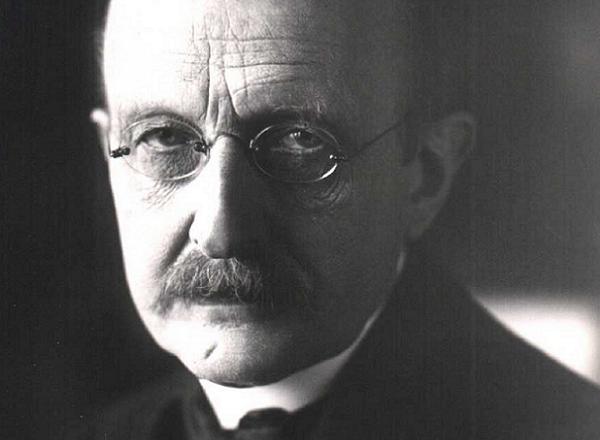
“I regard consciousness as fundamental. I regard matter as derivative from consciousness. We cannot get behind consciousness. Everything that we talk about, everything that we regard as existing, postulates consciousness.” [Nobel Laureate Physicist, Max Planck, Father of Quantum Theory]
On the fateful day of Dec 14, 1900, Max Planck presented one of the most revolutionary papers in the history of humankind, the paper that gave birth to the theory of quantum mechanics and changed our perception of the observed universe at the microscale in the most unexpected manner. Max Planck presented his paper titled Zur Theorie des Gesetzes der Energieverteilung im Normalspektrum, explaining the theory of the Law of Energy Distribution in Normal Spectrum at a meeting of the German Physical Society in Berlin. [anon]
“As a man who has devoted his whole life to the most clear headed science, to the study of matter, I can tell you as a result of my research about atoms this much: There is no matter as such. All matter originates and exists only by virtue of a force which brings the particle of an atom to vibration and holds this most minute solar system of the atom together. We must assume behind this force the existence of a conscious and intelligent mind. This mind is the matrix of all matter.” - Max Planck, Florence, Italy, 1944]
Max Planck introduced a bold idea in nineteen hundred to solve a problem physicists could not explain. Scientists were studying black body radiation and the data did not match the math of the time. Planck proposed that energy is not smooth or continuous. Instead it comes in tiny fixed packets. He called these packets quanta. Each quantum carries a specific amount of energy. This amount depends on the frequency of the radiation involved. The higher the frequency the more energy each quantum holds. This idea changed the way scientists understood heat light and matter. Planck showed that energy follows the rule E equals h times f. The symbol h represents the Planck constant. The symbol f represents the frequency. This formula explained the black body radiation curve and matched the observations perfectly. It revealed a new structure inside nature. His idea opened the door to quantum mechanics. Later scientists used his work to explain atoms electrons and the strange behavior of particles at small scales. Without the concept of quanta the modern picture of physics would not exist. Plancks theory became the starting point for a major shift in science. Today the quantum idea appears in lasers computers solar cells and many other technologies. Plancks insight showed that nature works in steps not smooth flows. This simple but powerful idea continues to guide research and helps us understand the smallest parts of the universe.
“Besides inventing quantum theory, Planck had made another great contribution to science by welcoming and generously supporting the young Albert Einstein. In 1905, when Einstein, then an unknown employee of the Swiss patent office in Bern, sent five revolutionary papers to the physics journal that Planck edited in Berlin, Planck immediately recognized them as works of genius and published them quickly without sending them to referees. He did not agree with all of Einstein’s ideas, but he published all of them. He helped Einstein to move ahead in the academic world, and in 1913 invited him to a full professorship in Berlin. For twenty years Planck and Einstein were friends and colleagues in Berlin, leaders of a scientific community that remained creative and vibrant, in spite of the political and economic disarray that surrounded them. Planck was the rock-solid central figure of German science, with the vision to promote the unorthodox and unpatriotic citizen-of-the-world Einstein.”
Munich, 1875. A physics professor sits across from a young student and delivers what should have been career-ending advice. "Don't waste your time," he warns. "Physics is essentially complete. Almost everything worth discovering has already been found."
The student's name was Max Planck. He could have walked away, chosen law or medicine, followed a safer path. Instead, he offered a response so humble it seemed almost naive: he wasn't interested in discovering new things. He just wanted to understand what was already there. To master the foundations.
That professor had no idea he was speaking to the man who would shatter the very foundations of classical physics.
By 1900, Planck was obsessing over a problem that seemed trivial to most: blackbody radiation. Why did heated objects emit light in the specific ways they did? The existing equations broke down catastrophically at high frequencies, predicting infinite energy—a troubling paradox that challenged thermodynamic principles.
Planck approached it like a puzzle, not a revolution. He introduced a mathematical trick: what if energy wasn't emitted smoothly, but in tiny, discrete packets? Chunks. Quanta. It was supposed to be temporary, just a mathematical convenience to make the numbers work.
But the numbers worked perfectly.
Too perfectly. Planck had stumbled onto something far deeper than a calculation fix. Energy itself was quantized. The smooth, continuous universe that Newton had built was actually grainy at its smallest scales, like a photograph dissolving into pixels under a microscope.
He didn't celebrate. He was deeply uncomfortable with his own discovery, spending years trying to reconcile it with classical physics. But the cat was out of the bag. Einstein would use Planck's quanta to explain the photoelectric effect. Bohr would build atomic models on it. Heisenberg and Schrödinger would take it even further.
Planck's constant, that tiny number he'd introduced as a stopgap, became one of the most fundamental values in all of physics. It appears in nearly every quantum equation, a permanent monument to the man who just wanted to understand the basics.
The professor was wrong. Everything wasn't already discovered. But he was also right in a way he never imagined: the real breakthroughs come from those who master what's already there, who understand the foundations so deeply they can see where they crack.
See Also
consciousness and matter
Fundamental Length
Mind In Matter
Planck Length
Plancks Constant
Quantum of Action
Solvay Conferences
Wheeler Hypothesis