
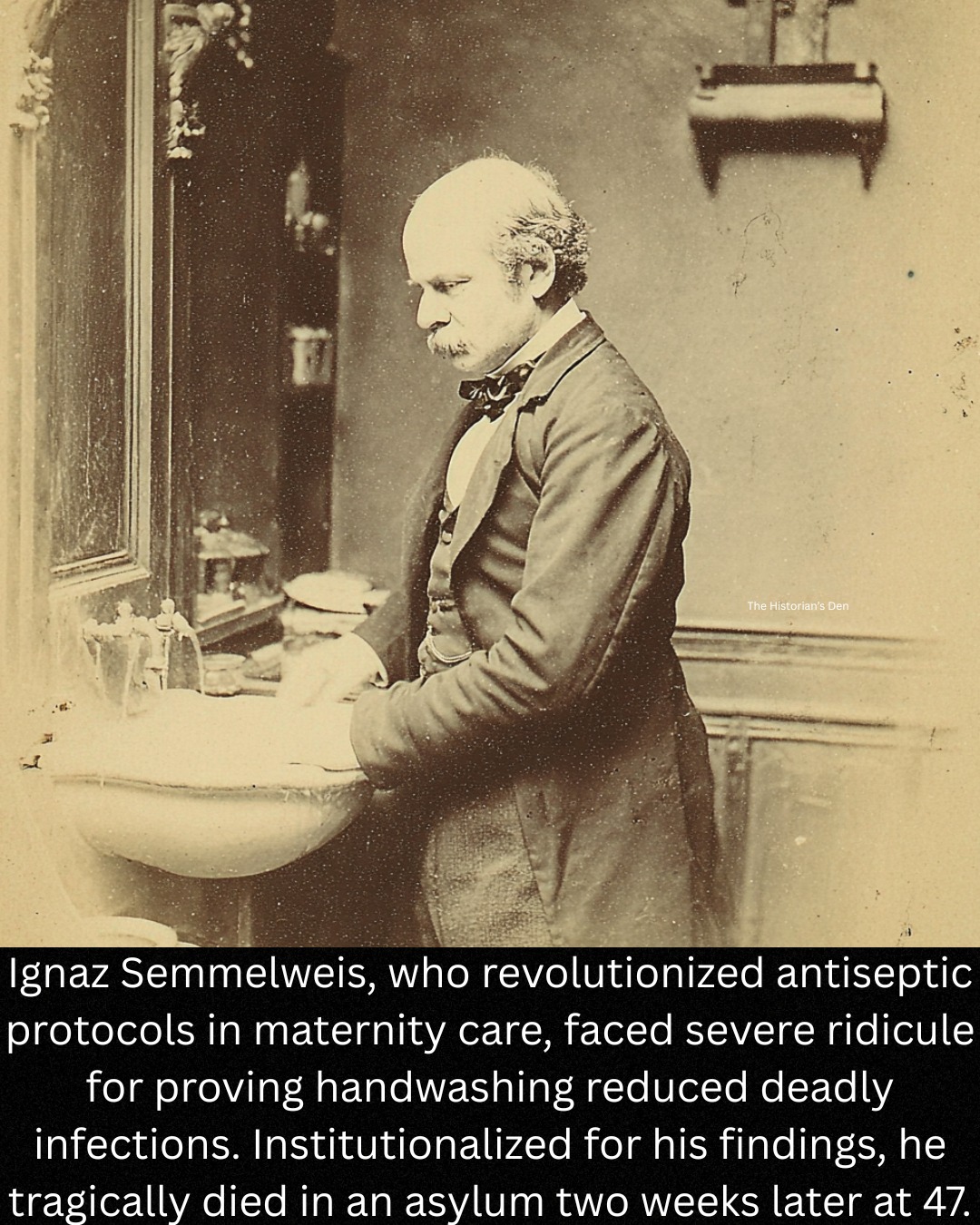
Despite various publications of results where hand washing reduced mortality to below 1%, Semmelweis's observations conflicted with the established scientific and medical opinions of the time and his ideas were rejected by the medical community. Semmelweis could offer no acceptable scientific explanation for his findings, and some doctors were offended at the suggestion that they should wash their hands. Semmelweis's practice earned widespread acceptance only years after his death, when Louis Pasteur confirmed the germ theory and Joseph Lister, acting on the French microbiologist's research, practiced and operated, using hygienic methods, with great success. In 1865, Semmelweis was committed to an asylum, where he died at age 47 of pyaemia, after being beaten by the guards, only 14 days after he was committed." https://en.wikipedia.org/wiki/Ignaz_Semmelweis
Semmelweis is everywhere in the institutional memory of medicine. His name is etched into hospitals, clinics, universities, and research institutes; statues stand in Budapest, Vienna, Szeged, New York’s Wadsworth Center, Florence, and Geneva at WHO headquarters, while busts and memorials appear in museums and former hospitals across Central Europe. His face has appeared on postage stamps and commemorative coins; entire museums are devoted to him. Within professional discourse he's cited in endless medical lectures, introductory textbooks, anniversary addresses, academic conferences, a kind of compulsory figure whose invocation reflects alignment with orthodoxy. Yet despite this ubiquity, the substance of what he wrote has all but vanished. The 500 pages of his Etiology, Concept, and Prophylaxis of Childbed Fever are barely read, its intricate tables, case series, and polemical reflections ignored. What circulates instead is an extraordinarily abbreviated epitome, such as Semmelweis “anticipated germ theory,” or he “proved infection was contagious.” This repetitive caricature has displaced all possibility of serious engagement—detailed analysis has disappeared, exegesis has been altogether avoided, the conceptual stakes of his reasoning have been left without acknowledgement, and the broader philosophical implications of his work have been consigned to an obliviscence so thorough that even specialists fail to register their absence. The explanation lies in the incompatibility between his actual findings and the doctrinal function they're made to serve. Chlorine hand-washing, stripped to its clinical facticity, does not vindicate Pasteur and does not establish contagion. And the questions that arise from his evidence make this incompatibility glaring: if “infection” were truly microbial in the sense later imagined, why would washing only the hands suffice, when the air of the ward, the instruments, the linens, and the beds themselves were never disinfected? And if microbial contagion were decisive, why did the same doctors who failed to wash their hands in countless other interactions with the same patients—during examinations, dressings, and ward rounds—not produce identical mortality patterns? To press either of these questions even briefly is to dissolve the edifice into incoherence. Hence the endless invocation: Semmelweis functions as a hagiographic mantra, a ritualised signifier whose dogmatic reiteration wards off scrutiny. In this sense he's become less a historical figure than a catechetical emblem, indispensable to the mythology of medicine precisely because his original words have been effaced. [anon]
See Also