
George Washington Carver (1864 – January 5, 1943) was an American agricultural scientist and inventor who promoted alternative crops to cotton and methods to prevent soil depletion. He was the most prominent black scientist of the early 20th century.
While a professor at Tuskegee Institute, Carver developed techniques to improve soils depleted by repeated plantings of cotton. He wanted poor farmers to grow other crops, such as peanuts and sweet potatoes, as a source of their own food and to improve their quality of life. The most popular of his 44 practical bulletins for farmers contained 105 food recipes using peanuts. Although he spent years developing and promoting numerous products made from peanuts, none became commercially successful. https://en.wikipedia.org/wiki/George_Washington_Carver
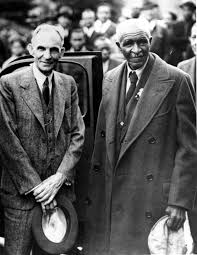
This day in history 1942: George Washington Carver begins experimental project with Henry Ford
The agricultural chemist George Washington Carver, head of Alabama’s famed Tuskegee Institute, arrives in Dearborn, Michigan at the invitation of Henry Ford, founder of Ford Motor Company.
Born to slave parents in Missouri during the Civil War, Carver managed to get a high school education while working as a farmhand in Kansas in his late 20s. Turned away by a Kansas university because he was an African American, Carver later became the first black student at Iowa State Agricultural College in Ames, where he obtained his bachelor’s and master’s degrees. In 1896, Carver left Iowa to head the department of agriculture at the Tuskegee Normal and Industrial Institute, a school founded by the leading black educator Booker T. Washington. By convincing farmers in the South to plant peanuts as an alternative to cotton, Carver helped resuscitate the region’s agriculture; in the process, he became one of the most respected and influential scientists in the country.
Like Carver, Ford was deeply interested in the regenerative properties of soil and the potential of alternative crops such as peanuts and soybeans to produce plastics, paint, fuel and other products. Ford had long believed that the world would eventually need a substitute for gasoline, and supported the production of ethanol (or grain alcohol) as an alternative fuel. In 1942, he would showcase a car with a lightweight plastic body made from soybeans. Ford and Carver began corresponding via letter in 1934, and their mutual admiration deepened after Carver made a visit to Michigan in 1937. As Douglas Brinkley writes in “Wheels for the World,” his history of Ford, the automaker donated generously to the Tuskegee Institute, helping finance Carver’s experiments, and Carver in turn spent a period of time helping to oversee crops at the Ford plantation in Ways, Georgia.
By the time World War II began, Ford had made repeated journeys to Tuskegee to convince Carver to come to Dearborn and help him develop a synthetic rubber to help compensate for wartime rubber shortages. Carver arrived on July 19, 1942, and set up a laboratory in an old water works building in Dearborn. He and Ford experimented with different crops, including sweet potatoes and dandelions, eventually devising a way to make the rubber substitute from goldenrod, a plant weed. Carver died in January 1943, Ford in April 1947, but the relationship between their two institutions continued to flourish.
They traded him for a horse.
He was six weeks old, dying of whooping cough, and worth less than livestock—then he changed American agriculture forever.
George Washington Carver was born into slavery sometime around 1864 in Diamond Grove, Missouri. He never knew the exact date. Enslaved people weren't worth recording that carefully.
His father—a man from the neighboring plantation—died in a logging accident shortly before George was born. Crushed under an oxen wagon hauling wood. George never met him.
Six weeks later, night raiders stormed the Carver farm.
They kidnapped baby George, his mother Mary, and his sister. Confederate bushwhackers who roamed Missouri during the Civil War, stealing enslaved people to sell farther south. It was common practice. Profitable.
Moses Carver—the German immigrant who owned George's mother—sent a neighbor to track them down. Not to rescue. To recover property.
The neighbor found the raiders in Arkansas. He negotiated.
Moses Carver's finest racehorse in exchange for whatever they'd give back.
The raiders took the horse. They handed over one thing: a dying infant with whooping cough.
Baby George. Barely breathing.
His mother and sister? Gone. Sold. Never heard from again.
George Washington Carver was six weeks old. Orphaned. Dying. Worth less than a horse.
Moses and Susan Carver didn't expect him to survive. He was so frail, so sick, they prepared for him to die any day.
But he didn't.
He lived. Weak, sickly, unable to work the fields like his brother Jim. So George stayed inside, learning to cook, clean, sew, mend clothes, do laundry. Women's work. Domestic chores.
And he wandered the woods.
"I literally lived in the woods," he later wrote. "I wanted to know the name of every stone and flower and insect and bird and beast. I wanted to know where it got its color, where it got its life."
He became obsessed with plants. Neighbors started calling him "the Plant Doctor" because he could nurse dying crops back to health when no one else could. He'd experiment with different soils, test amounts of sunlight and water, track down damaging insects.
When the Carvers' finest apple tree started dying, ten-year-old George crawled along its branches until he found colonies of codling moths.
"Saw off those branches," he told Moses Carver. "The tree will get well."
It did.
But there was no school for Black children near Diamond Grove. So at age ten—maybe eleven, records aren't clear—George heard about a school in Neosho. Eight miles away.
He had no money. No place to live. No plan.
He left anyway.
He slept in a barn. Did odd jobs to survive. Eventually, a Black couple named Andrew and Mariah Watkins took him in. Mariah taught him one thing that changed everything:
"You must learn all you can, then go back out into the world and give your learning back to the people."
George would repeat those words for the rest of his life.
He stayed in Neosho until he'd learned everything the teacher knew. Then he left again. Traveling from town to town across Kansas and Missouri through the 1870s and 1880s. Working as a cook, doing laundry, whatever it took. Always moving toward more education.
At one point, he was accepted to Highland College in Kansas. Then they saw he was Black.
They rejected him.
He kept going.
Finally, at Simpson College in Iowa, they let him study. He majored in art. One of his paintings won honorable mention at the 1893 Chicago World's Fair.
But a professor pulled him aside. "George, there's not much hope for a Black man in art. Have you considered agricultural science?"
In 1890, Carver transferred to Iowa State Agricultural College. He earned his bachelor's degree in 1894. His master's degree in agriculture in 1896.
He became the first Black faculty member at Iowa State.
That same year, he received a letter from Booker T. Washington at Tuskegee Institute in Alabama:
"I cannot offer you money, position or fame. The first two you have. The last, from the place you now occupy, you will no doubt achieve. These things I now ask you to give up. I offer you in their place work—hard, hard work—the challenge of bringing people from degradation, poverty and waste to full manhood."
Carver left Iowa. He went to Tuskegee. He stayed for forty-seven years.
The South was dying. Decades of cotton monoculture had destroyed the soil. Farmers—especially poor Black sharecroppers—were starving. The boll weevil was wiping out what little cotton remained.
Carver looked at the depleted fields and saw possibility.
He taught farmers to rotate crops. Plant peanuts. Sweet potatoes. Soybeans. Crops that would restore nitrogen to the soil.
But farmers resisted. "Who's going to buy peanuts?" they asked. "We can't eat peanuts for every meal. We can't sell them."
So Carver went into his laboratory and got to work.
He discovered 300 uses for peanuts. Three hundred.
Peanut milk. Peanut flour. Peanut ink. Peanut dyes. Peanut plastics. Peanut soap. Peanut cosmetics. Peanut wood stains. Peanut cheese. Peanut coffee. Peanut cooking oil. Peanut medicinal oils.
He found 118 uses for sweet potatoes. Seventy-five uses for pecans.
In 1915, peanuts were grown on about half a million acres in the South.
By 1918? Over four million acres.
Carver had transformed Southern agriculture. He'd created an entire industry. He'd given impoverished farmers a way to survive.
And he did it with almost no laboratory equipment. When he arrived at Tuskegee, there was no money for supplies. So Carver sent his students into alleys to collect discarded bottles, broken china, bits of rubber, scraps of wire.
He built his laboratory from garbage.
"It is simply service that measures success," he said.
In 1921, Carver testified before Congress about tariffs on peanuts. They gave him ten minutes to speak.
He spoke for nearly two hours. The committee was transfixed.
His fame grew. Henry Ford became his friend, visiting regularly, installing an elevator in Carver's dormitory so the aging scientist wouldn't have to climb stairs. Thomas Edison offered him a job. Carver declined. He stayed at Tuskegee.
He could have been wealthy. He patented only three of his inventions—and those weren't commercially successful.
He didn't care about money.
When he died in 1943 at age 78, his life savings totaled about $60,000—substantial for someone who'd lived so frugally. Every penny went to the George Washington Carver Foundation to support young Black scientists.
On his grave, they wrote: "He could have added fortune to fame, but caring for neither, he found happiness and honor in being helpful to the world."
Upon Carver's death, Franklin D. Roosevelt sent a message:
"All mankind are the beneficiaries of his discoveries in the field of agricultural chemistry. The things which he achieved in the face of early handicaps will for all time afford an inspiring example to youth everywhere."
Six months later, Congress created the George Washington Carver National Monument in Missouri—the first national memorial to an African American.
The baby traded for a horse. The boy worth less than livestock. The orphan who wasn't supposed to survive.
He transformed American agriculture. He saved the Southern economy. He pioneered hundreds of products we still use today.
And he did it all because a Black woman named Mariah Watkins once told a homeless ten-year-old boy: "Learn all you can, then give your learning back to the people."
George Washington Carver spent seventy-eight years giving his learning back.
Born enslaved. Orphaned at six weeks. Traded for a horse.
Died one of the most celebrated scientists in American history.
That's not just survival. That's revolution.
The gray dust of Macon County, Alabama, did not smell like earth. It smelled like ash. In October of 1896, a man in a crisp suit knelt in a field that had refused to grow a crop for three years. He ran the dry powder through long, sensitive fingers.
There was no life in it. The man was George Washington Carver, and he had just arrived from Iowa State University. He held a master’s degree in agricultural science, but standing there in the heat, he realized his degree meant nothing to this dead ground. The soil was not resting. It was starving.
He looked up at the farmhouse. It was a single-room shack with gaping holes in the walls. The family watching him was gaunt, their eyes hollow from a diet of salt pork and cornmeal. They were waiting for him to leave so they could go back to worrying about how to survive the winter. They did not know that the man kneeling in their dirt was about to start a war against the economy of the entire South.
The problem was visible in every direction. For decades, the South had planted only one thing. Cotton was the currency, the culture, and the king. But cotton is a cruel master. It acts like a vampire to the soil, sucking out the nitrogen and nutrients until the earth turns to dust.
In the late 19th century, the cycle was brutal. Farmers, both Black and white, lived as sharecroppers. They did not own the land they worked. They borrowed tools, seeds, and food from the landowner or the local merchant, promising to pay it back with the harvest. It was a system designed to keep people in debt.
When the soil died, the harvest failed. When the harvest failed, the debt grew. Families were trapped in a prison without bars, bound to land that could no longer feed them. Carver saw this within his first month at the Tuskegee Institute. He saw children with bowed legs from rickets and swollen bellies from pellagra. He realized that before he could be a scientist, he had to be a survivalist.
He tried to explain the chemistry. He told them that the land needed to rest from cotton. He told them to plant cowpeas, sweet potatoes, or peanuts—crops that would pull nitrogen from the air and put it back into the ground.
The system did not allow it.
The Southern agricultural economy was a locked engine. Banks and merchants would not lend money for peanuts or peas. They only recognized cotton. The "crop lien" system meant that a farmer’s future harvest was already owned by the merchant before a single seed was planted. If a farmer tried to plant sweet potatoes to feed his starving children, the merchant cut off his credit. No credit meant no tools, no seed, and no food for the winter. The rule was absolute: Plant cotton, or starve immediately.
This economic machine worked perfectly for the few who owned the ledgers. It worked until it met a man who did not care about money, but cared deeply about nitrogen.
Carver stood on a porch in 1897, holding a handful of dried cowpeas. He offered them to a weathered farmer who had just lost his entire cotton crop to disease. The farmer looked at the peas, then at his barren field, and shook his head. He didn't take them. He couldn't. Taking the peas meant breaking the contract with the merchant. It was a quiet rejection, born of fear. Carver put the peas back in his pocket. He realized then that being right was not enough.
He retreated to his laboratory, but not to hide. He began to experiment not with high-yield fertilizers that the poor could not afford, but with swamp muck and forest leaves. He turned compost into gold. But he knew the farmers would not come to the school. They were too tired, too poor, and too ashamed of their clothes.
If the people could not go to the school, the school would have to go to the people.
Carver designed a wagon. It was known as the Jesup Agricultural Wagon, a "Movable School." It was a strange sight—a sturdy carriage loaded with churns, jars, seeds, and plows, pulled by mules across the rough, red-clay roads.
The struggle was slow and exhausting. Carver would pull the wagon up to a church or a dusty crossroads. People would gather, skeptical. They expected a preacher or a tax collector. Instead, they got a man with a high voice who rolled up his sleeves and started digging in the dirt.
He did not lecture them on chemistry. He showed them. He would take a small patch of their ruined land and work it his way. He used the muck from the swamps to fertilize it. He planted the "forbidden" crops—the legumes and the sweet potatoes.
Week after week, month after month, he returned. The farmers watched. They saw the patch of land Carver tended turn dark and rich. They saw the cotton in his demonstration plot grow tall, while their own plants remained stunted.
But the fear of the merchants remained. To break it, Carver had to prove that the alternative crops had value. He wasn't just fighting bad farming; he was fighting the market. If they couldn't sell peanuts, they wouldn't plant them.
So, he went into his laboratory at dawn and came out at dusk. He took the humble peanut and the sweet potato and dismantled them chemically. He found milk, oil, flour, dyes, and soaps hidden inside. He created recipes. He printed bulletins on cheap paper—simple guides on how to cook and preserve these new crops so that even if the merchants wouldn't buy them, the families could eat them.
He handed out these bulletins from the back of his wagon. He cooked meals for the farmers' wives, showing them that the "weed" called the peanut could replace the expensive meat they couldn't afford.
Slowly, the grip of the system loosened. A farmer here, a family there, began to hide a patch of peanuts or sweet potatoes in the back acres. They saw their children grow stronger. They saw the soil in those patches turn dark again. When the boll weevil beetle eventually marched across the South, devouring the cotton fields and bankrupting the old system, the farmers who had listened to the man on the wagon did not starve. They had something else to sell. They had something else to eat.
Carver never patented his discoveries. He claimed the methods came from God and belonged to the people. By the time he was an old man, the South was green again. The gray dust was gone, buried under layers of rich, restored earth.
He had not just fixed the soil. He had broken the economic chains that bound the poor to a dying crop. He proved that science only matters when it serves the person with the least amount of power.
Sources: Tuskegee University Archives; McMurry, L. O. (1981), George Washington Carver: Scientist and Symbol.
See Also