
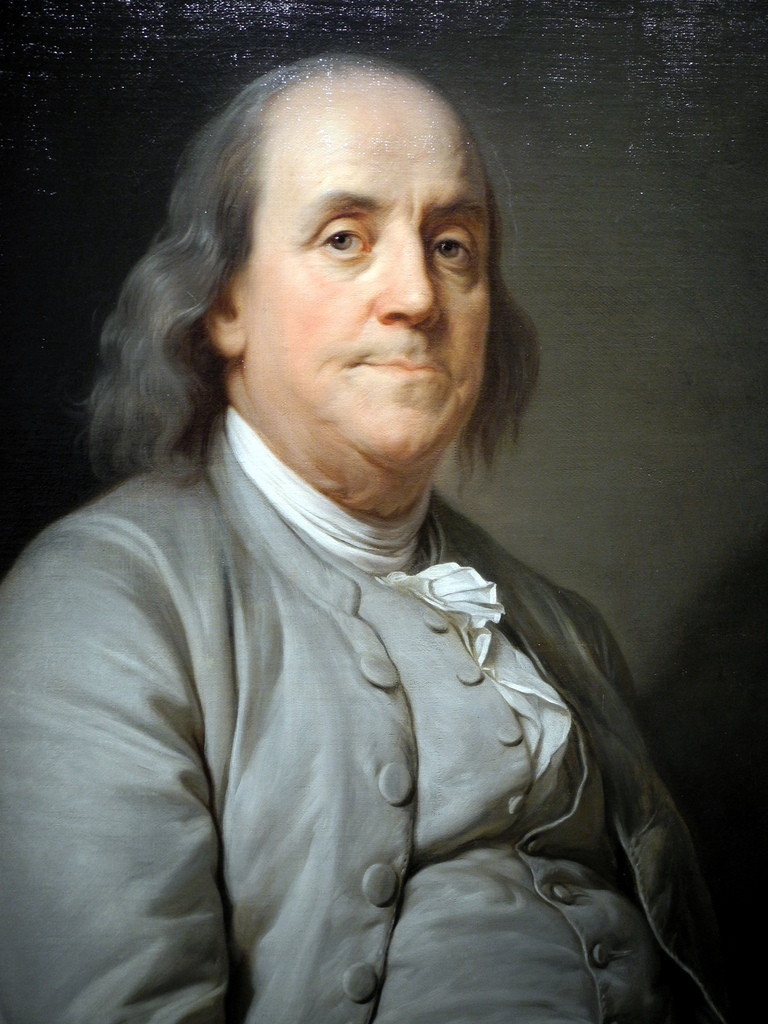
Benjamin Franklin (January 17, 1706 (O.S. January 6, 1705) - April 17, 1790) was one of the Founding Fathers of the United States of America. A noted polymath, Franklin was a leading author and printer, satirist, political theorist, politician, scientist, inventor, civic activist, statesman, soldier, and diplomat. As a scientist, he was a major figure in the Enlightenment and the history of physics for his discoveries and theories regarding electricity. He invented the lightning rod, bifocals, the Franklin stove, a carriage odometer, and the glass 'armonica'. He formed both the first public lending library in America and the first fire department in Pennsylvania. He was an early proponent of colonial unity, and as a political writer and activist, he supported the idea of an American nation. As a diplomat during the American Revolution, he secured the French alliance that helped to make independence of the United States possible. [from Wikipedia]
Benjamin Franklin’s 9 Most Ingenious Inventions
The Founding Father rejected patents on the belief that ideas should be shared.
1. Lightning Rod
Franklin’s most famous invention, the lightning rod, was born from his experiments with electricity in the late 1740s. An early description of his idea to protect buildings and ships from “electrical fire” appeared in a 1750 letter to Peter Collinson of The Royal Society in London, but it wasn’t until the 1752 demonstrations of lightning’s electrical qualities—first in France, then with Franklin’s kite experiment—that the first lightning rods were installed in Philadelphia.
2. Swim Fins
Centuries after Leonardo da Vinci suggested something similar, 11-year-old Franklin devised the first working swim fins: a pair of “oval paddles, each about 10 inches long and 6 inches wide, with a hole for the thumb, so I could hold them against the palm of my hand.” Although the fins helped him swim faster, the inventor complained that they “fatigued” his wrists and his attempt at fins for his feet didn’t work particularly well.
On the other hand, he enjoyed the “greatest pleasure imaginable” when he discovered he could be pulled across a pond by a kite on a string—a precursor to today’s kitesurfing. It was because of these innovations and his lifelong promotion and enthusiasm for aquatic activity that Franklin was inducted into the International Swimming Hall of Fame in 1968.
3. Three-Wheeled Clock
Sometime before 1758, Franklin designed a 12-hour clock that was mechanically simpler than other options of the period. Backed by an interlocking mechanism of three wheels and two pinions, the clock featured two dials: The smaller one counted off seconds, while the larger one displayed hours and minutes in a four-quadrant design. Instead of each hour getting its own position on the clockface, four groups of hour numbers were stacked and aligned to the cardinal directions. Each quadrant then featured 60 minute markings along the face’s circumference. Although Franklin later claimed to have seen versions of his clock in Paris, he never published his own account of this invention. The lone description of this timepiece comes from a 1773 publication by James Ferguson, who noted that the clock “measures time exceedingly well.”
4. Franklin Stove
As far back as the late 1730s, Franklin began developing an iron fireplace intended to conserve wood and heat homes more effectively. The first iteration of what he called the “Pennsylvania Fire-Place” was built with an air box, a baffled chamber behind the fire which drew in smoke-free air from below that was heated as it rose before being expelled through vents. Additionally, a U-shaped siphon funneled smoke over the air box, under the back of the stove then up the chimney. Although Pennsylvania Deputy Governor George Thomas was impressed with the creation, Franklin’s stove didn’t perform as effectively as he hoped, and the inventor attempted to improve on the design for much of the rest of his life.
5. Phonetic Alphabet
In 1768, Franklin unveiled what he described as an attempt to “give the alphabet a more natural order.” Explaining that each letter should only be associated with one sound, he did away with six he considered superfluous: C, J, Q, W, X and Y. Franklin also introduced six new letters, including those that represented the sounds of “sh,” “ng” and “um.” Despite the zeal he showed for his alphabet in correspondence from that period, Franklin seemingly lost interest shortly afterward, and the system never gained traction despite being endorsed by lexicographer and dictionary namesake Noah Webster two decades later.
6. Flexible Catheter
Seeking to aid his kidney stone-stricken brother John, in 1752, Franklin devised a catheter that could be inserted through the urinary passage in a relatively pain-free manner. The solution lay in the creation of a hinged silver tube that was more flexible than the standard rigid metal versions of the era. However, this tube could also be stiffened by the insertion of a metal wire that lengthened and retracted by way of a turning screw. Although Franklin might not have been the first to conceive of this particular item, as flexible catheters had been around in Europe for some time, his is considered the first to be used in America.
7. Improved Street Lamp
Franklin’s many interests included plans for keeping the streets of Philadelphia well-maintained; to that end, he advocated for the installation of street lamps around 1757. He also proposed a design that improved on the existing globe lamps imported from London, which became murky as smoke collected within the enclosed glass. Franklin’s invention had a funnel at the top and vents below that enabled the passage of smoke, keeping the lighting sharp and preventing the need for daily cleaning.
8. Glass Armonica
Intrigued by a performance of the glass harp, in which upright glasses are “played” as moistened fingers trace around their rims, Franklin commissioned a London glassblower to build an instrument based on the same physical principles. The result was 37 glass bowls, fashioned in specific dimensions to produce distinct musical notes, that fit together on a horizontal iron spindle that could be turned with a foot pedal. Its name taken from the Italian word for harmony, the glass armonica gained a prominent following after its 1762 debut, with luminaries such as Mozart and Beethoven incorporating the instrument’s ethereal sounds into compositions.
9. Bifocals
Usually depicted wearing glasses, Franklin’s later-life eyewear was yet another device born of innovative impulses. As he described (and sketched) in a May 1785 letter to London merchant George Whatley, Franklin had an optician fashion “double spectacles” that satisfied his need for lenses to accommodate both near- and farsightedness; by combining them into one piece, Franklin wrote, “I have only to move my eyes up or down as I want to see distinctly far or near, the proper glasses being always ready.” Although some historians question the timeline for when Franklin first donned what later became known as bifocals, and whether he deserves full credit as the inventor, he is generally believed to have originated them in 1784.
Source: Tim Ott for History
236 years ago today [April 16, 2026], the most extraordinary American who ever lived died in his bed in Philadelphia at the age of 84. He had been a candle maker's apprentice, a runaway teenager, a printer, a scientist, an inventor, a diplomat, a philosopher, a Founding Father, and the man who talked France into helping America win its independence. Twenty thousand people came to his funeral. The French National Assembly went into mourning for three days.
His name was Benjamin Franklin.
Born January 17, 1706, in Boston, Massachusetts — the fifteenth of seventeen children of Josiah Franklin, a candle and soap maker who had emigrated from England, and Abiah Folger, a woman of Nantucket. The family was poor. Benjamin had two years of formal schooling — just two years — before his father pulled him out because he could not afford the fees.
At ten years old he was working in his father's candle shop. At twelve he was apprenticed to his older brother James, a printer. At fifteen he was secretly writing essays for his brother's newspaper under the pseudonym Silence Dogood — a sharp-tongued, witty, fiercely independent widow who became one of the most popular voices in Boston without anyone knowing she was a twelve-year-old boy.
At seventeen he ran away.
He walked into Philadelphia on a Sunday morning in 1723 carrying everything he owned — hungry, tired, with three rolls of bread, one under each arm and one in his mouth. A girl named Deborah Read watched him from her front doorstep and thought he looked ridiculous. He noticed her. Seven years later they were married.
He spent the next sixty years building one of the most remarkable lives in the history of civilization.
As a printer and publisher he became one of the most influential voices in colonial America. The Pennsylvania Gazette — his newspaper — was the most widely read in the colonies. Poor Richard's Almanack — published every year from 1732 to 1757 under the pen name Richard Saunders — sold nearly ten thousand copies a year and filled American homes with the wit and practical wisdom that still echo in American culture. A penny saved is a penny earned. An ounce of prevention is worth a pound of cure. Early to bed and early to rise makes a man healthy wealthy and wise. These were not folk sayings. They were Franklin's.
As a scientist he was the most celebrated in the world. He proved that lightning was electricity — through the kite experiment in 1752, flying a kite with a metal key in a thunderstorm and drawing the electrical charge down a wet string into a Leyden jar. He invented the lightning rod that protected buildings across the world. He invented bifocals. He invented the flexible urinary catheter. He invented the Franklin stove. He invented swim fins. He discovered the Gulf Stream. He invented a musical instrument — the glass armonica — for which Mozart and Beethoven both composed pieces. He did all of this with two years of formal schooling.
He was elected to the Royal Society of London — the most prestigious scientific body in the world — on the strength of his electrical experiments. The French philosopher Kant called him the Prometheus of modern times. David Hume called him America's first great man of letters.
But his greatest work was political.
When the American Revolution came he was already 70 years old — an age at which most men of his era were dead. He had spent years in London arguing the colonies' case to the British Parliament. He had helped draft the Declaration of Independence in 1776. He had signed it. Then Congress sent him to France — the most important diplomatic assignment in American history.
He spent nine years in Paris as America's minister to France. He was the most famous American alive and one of the most famous people in the world. The French adored him. He played the role perfectly — the plain Quaker hat, the simple clothes, the wit, the warmth, the total absence of European court pretension. He secured the military alliance with France in 1778 that was absolutely essential to American victory. Without French troops and the French fleet, Washington almost certainly could not have won at Yorktown in 1781.
Without Benjamin Franklin there is no Treaty of Paris. Without the Treaty of Paris there is no United States.
He came home in 1785. He was 79 years old. He served as president of Pennsylvania. At 81 he was the oldest delegate to the Constitutional Convention — carried to the sessions in a sedan chair because he was too frail to walk. He used his enormous prestige to broker the compromises that got the Constitution signed.
His very last public act — signed two months before he died — was a petition to Congress calling for the immediate abolition of slavery.
He died on April 17, 1790, at eleven o'clock at night. His last words, spoken to his daughter who had asked him to shift position in bed so he could breathe more easily, were: A dying man can do nothing easy.
Twenty thousand people attended his funeral. The French National Assembly went into three days of official mourning. George Washington wore black.
In his will he left money to the cities of Boston and Philadelphia — to be held in trust for two hundred years and then used for the public good. When the trusts matured in 1990 they were worth more than six million dollars. They funded trade schools, science museums, scholarships and community projects.
He had planned it all before he died. Of course he had.
The candle maker's son who taught the world about lightning. The runaway teenager who helped create a nation. The old man in the sedan chair who used his last breath to say that all men deserved to be free.
Born with nothing. Built everything.
236 years ago today.
See Also